The Pentagon Papers and the Prior Restraint the Court Refused
Nine justices, ten opinions, and an injunction that lasted fifteen days — the ruling that still sets the ceiling for government censorship of the press
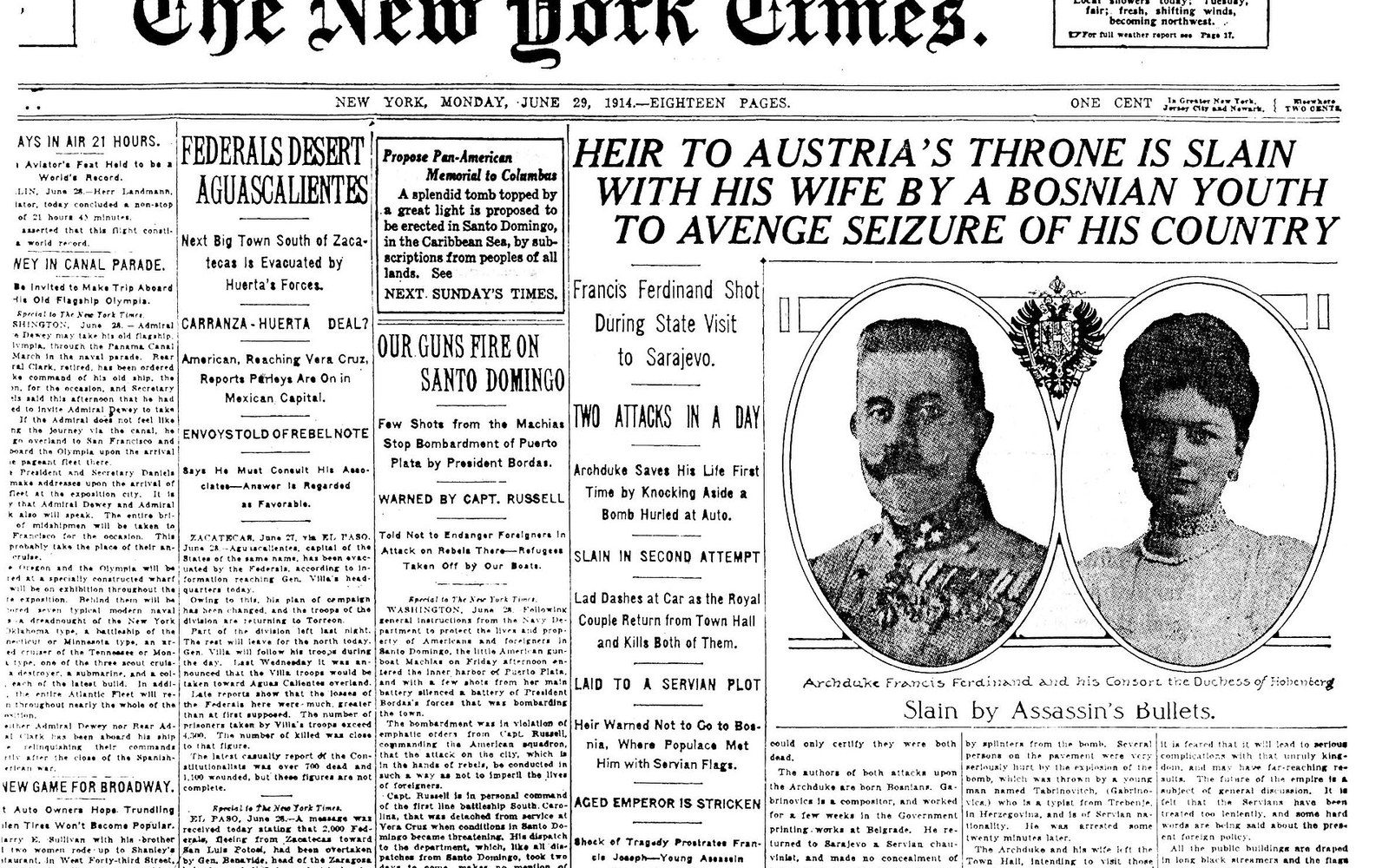
The Court refused the restraint and the papers resumed publishing.
Photo: Headline of the New York Times June-29-1914 · Wikimedia Commons
The Injunctions
On June 13, 1971, the New York Times began publishing excerpts from a classified Defense Department study of American decision-making in Vietnam. The documents, spanning more than seven thousand pages, had been leaked by former Pentagon analyst Daniel Ellsberg. The Nixon administration moved quickly: on June 15, the Justice Department obtained a temporary restraining order from a federal district court in New York, halting publication. The Washington Post, which had independently obtained portions of the study, began its own series three days after the Times was silenced — and the government's request for an injunction against it was turned down by a court in Washington, D.C.
Two circuit courts reached opposite conclusions. The Second Circuit upheld the restraint on the Times; the D.C. Circuit ruled for the Post. The conflict was clean enough to compel immediate Supreme Court review, and the case moved at a speed the Court almost never allows. Oral arguments were heard on June 26. The decision came down on June 30 — fifteen days after the first injunction, and among the fastest turns in the Court's modern history.

The web still runs at night in the plants that survived the consolidation.
Photo: Bornil Sarker / Pexels
What the Six-to-Three Said — and Didn't
New York Times Co. v. United States, 403 U.S. 713 (1971) produced a per curiam opinion of barely three hundred words. The majority lifted the injunctions. The government had not met the heavy burden required to justify a prior restraint — censorship before publication, as distinct from prosecution after. That was the holding. Beyond it, the case fractured into six separate concurring opinions and three dissents, each justice writing individually, which meant the per curiam itself established less doctrine than its outcome suggested.
Justice Hugo Black, joined by William O. Douglas, was the most absolute: the First Amendment permitted no prior restraint under any circumstance, and the word "press" in the Constitution meant what it said. Justice William Brennan drew the line more narrowly — a restraint might be permissible only if publication would "inevitably, directly, and immediately" endanger troops in the field, a standard the government's submissions had failed to meet. Justice Potter Stewart, joined by Byron White, accepted that some level of threat could theoretically justify suppression but found the government's evidence insufficient. Justice Thurgood Marshall focused on the absence of statutory authority: Congress had not granted the executive the power to seek these injunctions, and the Court should not supply it by implication.
The three dissenters — Chief Justice Warren Burger, Harry Blackmun, and John Marshall Harlan II — did not argue that the government's case was strong. They argued that fifteen days was not enough time to properly evaluate claims of national security damage, and that the lower courts had been rushed into error.

A final edition, bundled and unsold.
Photo: Maria Tyutina / Pexels
What the Case Left Open
Because no single rationale commanded a majority, the ruling's practical limits remained genuinely unsettled. The per curiam established that prior restraint carries a heavy presumption against its constitutionality and that the government bears the burden of overcoming it — but it did not define precisely what evidence would be sufficient. Brennan's formulation of imminent, direct, and inevitable harm has been the most cited in subsequent press freedom litigation, but it was the view of one justice, not a majority holding.
Prosecutors retained the ability to pursue post-publication criminal charges, as the White and Stewart concurrences explicitly noted. The government did pursue an Espionage Act prosecution against Ellsberg himself; that case collapsed in 1973 after evidence emerged of White House misconduct, including a break-in at Ellsberg's psychiatrist's office — conduct later central to the Watergate proceedings.
The Ellsberg prosecution's dismissal meant that the question of whether a source or a journalist could be criminally convicted for publishing classified material was left unresolved, a gap that has been tested repeatedly in the decades since. The Pentagon Papers case remains the authoritative statement on government censorship before the fact: the Court refused the injunction, emphatically, while leaving the edges of permissible restraint for the next argument to define.